
Imagination isn’t the part that gets hard. Somewhere past the hundred thousandth word a second job turns up, one with nothing to do with the writing: keeping track of who knows what, and when, and what you promised a reader in chapter four. That job isn’t writing, and it isn’t a test of how organised you are. It’s bookkeeping, and it’s the only part of this a tool can honestly take off you.
A hundred and eighty thousand words. A character who can’t know a particular thing until well past the middle, and who was in the room in an early scene you have since rewritten. A subplot you promised in the fourth chapter and haven’t thought about since. A minor character with two appearances thirty chapters apart, where the second only lands if the first is remembered.
You know all of it, in the sense that you could tell somebody if they asked today. Eleven months from now, coming back to a second draft after a break, you won’t. And the cut you make in week twenty-two will quietly take an obligation with it, because a scene that leaves takes its promises out of the book without mentioning it.
It surfaces as a thread that was set up and never paid off, or a detail that contradicts one from eighty pages earlier, and it’s always found by somebody else, usually after it’s too late to change cheaply. Not because you’re disorganised, but because you have been asked to hold a web in a format that only does lines.
A character isn’t eighty mentions scattered through a manuscript. A place isn’t a line in three chapters. Here each one is a single object you can open, and everything it touches is listed on it: every thread it runs through, every scene it appears in, everyone it has met, everything it knows and isn’t supposed to say yet. You write the connection once, when you notice it, and it’s there for the rest of the book.
What that buys you is the ability to see an absence. A thread that was set up and never paid off is a node with something coming in and nothing going out, and it’s visible rather than remembered. A character who has been off the board for eleven chapters looks like it. Two things that contradict each other are two lines meeting somewhere they shouldn’t. The continuity problems that get found in a structural edit stop needing to be found, because they’re shaped differently from everything around them.
And you can put the actual material on it. Drag the reference photographs onto the place, the research PDF onto the object, the recording of the interview you did for texture onto the person it came from, and they sit there and open in whatever normally opens them. The research doesn’t go into a folder named after the month you did it.
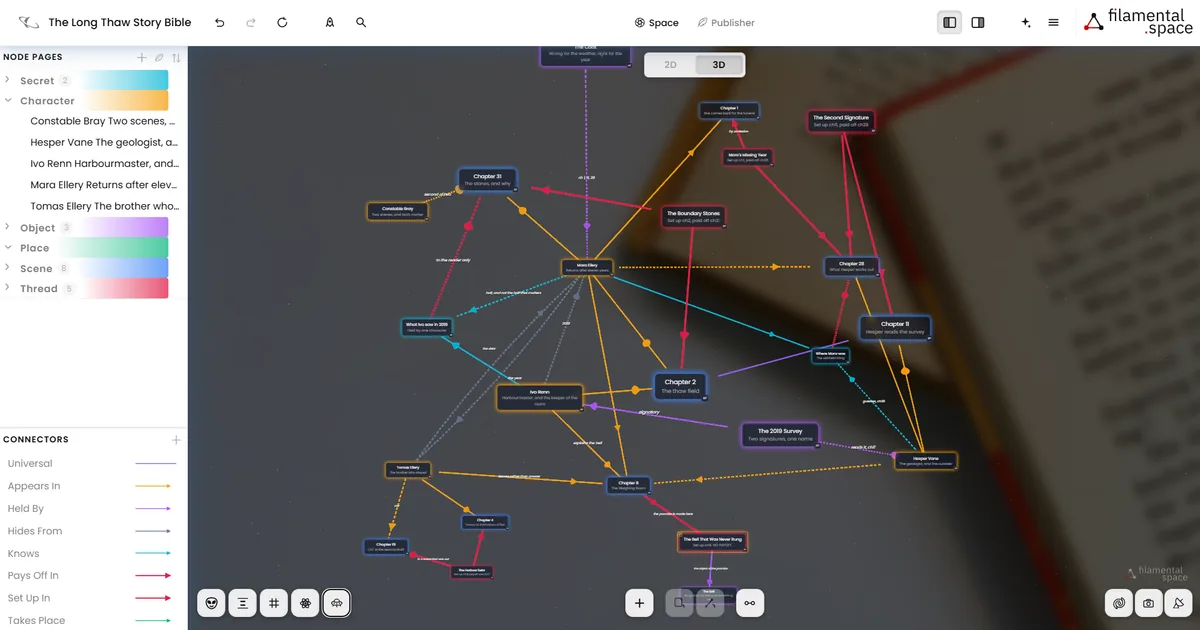
The Long Thaw is an invented literary mystery, thirty-one chapters, second draft. Its space holds what the book is made of rather than the book: the threads, the scenes that matter structurally, the characters, the objects and the secrets that decide who may say what and when. Nothing in it is prose, which stays in the manuscript where it belongs.
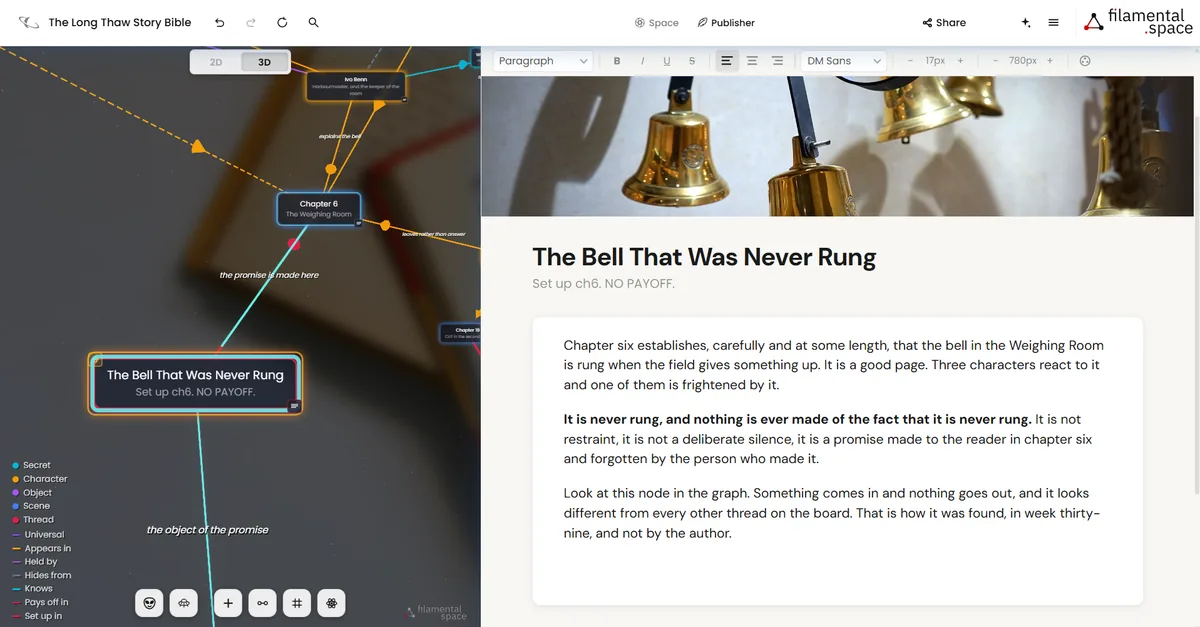
Four of the five threads behave. They’re set up in one chapter and paid off in another, and both ends are drawn. The fifth is the reason to look at it. Chapter six spends a careful page establishing that the bell in the Weighing Room is rung when the thaw field gives something up. Three characters react to it and one of them is frightened by it. It’s a good page, and the bell is never rung, and nothing is ever made of the fact that it’s never rung.
That isn’t restraint or a deliberate silence but a promise made to the reader in chapter six and lost somewhere in the eleven months after it, which is the most ordinary thing in the world and happens to everybody. In the graph it has an obvious shape: one line going in, nothing coming out, sitting beside four threads that all have both. It was found in a structural pass in week thirty-nine, by looking rather than by remembering.
The second case is subtler and more common. The harbour debt was paid off, in a chapter nineteen that was cut for pace in the second draft. The payoff still points at the cut scene, so the graph shows a thread reaching for something marked removed. That’s a different failure from the bell and it needs a different fix, and the only reason either is a decision rather than a discovery is that both are visible at the same time.
There’s structured data underneath, because that is what makes the connections work. You’ll probably never need to look at it, and it’s one keypress to hide the panels where it lives. Nothing is required, nothing is validated, and nothing nags you for leaving a field empty. What most people actually use is a name, some notes, and a line drawn to something else.
It doesn’t want your manuscript, so keep writing wherever you write. Nothing is imported, nothing is migrated, and your notes are plain text files in a folder you chose on your own machine, which means stopping tomorrow costs you nothing and loses you nothing. There’s no account, no sign-in and no telemetry, so nothing about an unfinished book goes anywhere at all.
It won’t write for you, plot for you, or tell you what happens next, and it isn’t trying to. That was always your job and it remains the good part. This is for the other job, the one nobody mentions when they describe the work.
At some point somebody outside asks for the shape of the thing. An editor taking a structural pass and needing to know what the fourth chapter was setting up. An agent trying to describe the book to a publisher. A collaborator joining book two, or a continuity reader coming to a series cold. A translator who needs to know which of two words is the same object.
Every one of them is asking for the same document, and it’s the one nobody writes, because writing it is a week of work that produces nothing new. A space can be sent as a link or a single file that opens in an ordinary browser, navigable, with the notes and the reference material attached where they belong. They install nothing, sign up for nothing and pay nothing, which is the only version of this that works when you are sending it to somebody who reads submissions all day.
A Template is a starting vocabulary, the kinds of thing that exist in a job and the ways they relate, so the categories are already there and already coloured when you make a space.
Being straight about it: none of the Templates is built for fiction. A novel starts from an empty vocabulary or from one of these bent out of shape. That takes about ten minutes, since a category is a name and a colour, and most people writing fiction end up with Character, Place, Thread, Object and Secret within the first sitting. That is exactly the vocabulary the worked example above uses, and it wasn’t planned, it’s just what the work asks for.
Everything on this page except the sending is on the free plan, permanently, with no account, no card and no trial quietly running out. Attachments aren’t limited. Nothing is withheld until you upgrade.
Spaces are unlimited and the bridges between them are free, so a long project becomes a few linked spaces rather than one enormous one: the cast in the first, the threads and the timeline in the second, the research in the third, all joined and all navigable. Each holds twenty nodes, which is roughly a cast.
The paid tier is $120 a year, or $12 a month, and buys exactly one thing: sending a space to somebody who doesn’t have Filamental. That’s the submission, the editor, the agent and the collaborator, and if none of those apply to you yet, you never need to pay. We would rather say so than sell you something you won’t use.
No. There’s structured data underneath, because that is what makes the connections work, and you can go your whole life without opening it. Panels you don’t want are hidden with a single key, and the parts most people actually use are a name, some notes and a line drawn to something else. Nothing is required to be filled in, and nothing nags you for leaving it empty.
No, and you should keep them. It doesn’t want your manuscript and it won’t format, export or typeset anything. It sits beside the thing you write in and holds what the book is made of: the characters, places, threads, objects and promises that recur, and how they relate to each other. The prose stays where the prose lives.
A document holds the facts and loses the relationships. In a document, a thread set up in chapter six and never paid off looks exactly like a thread that was paid off, because both are just paragraphs. Held as a structure, the unpaid one has something going into it and nothing coming out, so it’s a different shape on the screen rather than something you have to remember to check.
No, and it isn’t trying to. It won’t suggest what happens next, name your characters or produce prose. That was always your job and it remains the good part of the job. You can connect your own AI if you want one to read the structure and answer questions about it, and that’s your key, your account and your choice, with nothing switched on by default.
No. Everything is Markdown files with a few lines of structured data at the top, sitting in an ordinary folder you chose, on your own machine. Stop using it tomorrow and every note you wrote is still readable in any text editor on any computer. There’s no database, no export step and no account, so there’s nothing to be locked out of.
Yes. Publisher turns a space into a document you send as a link or a single HTML file, and it opens in an ordinary browser with the structure navigable inside it. Whoever receives it installs nothing, creates no account and pays nothing, which matters when you are sending it to somebody who reads submissions all day and won’t download software. One published link at a time is free, and the paid tier, at $120 a year or $12 a month, adds more links, updates to a link already sent, the HTML download and presenting.
One evening and the book you’re already writing is enough to find out whether this suits how you think. Free, no account, no card, and nothing that leaves your machine.